Buying macadamia nuts internationally for the first time can feel opaque: unfamiliar grades, prices quoted per tonne, Incoterms you half-remember, and a stack of export documents. This guide walks through exactly how to buy macadamia nuts from Zimbabwe — from choosing a grade to landing your first container.
Step 1: Decide NIS or kernel
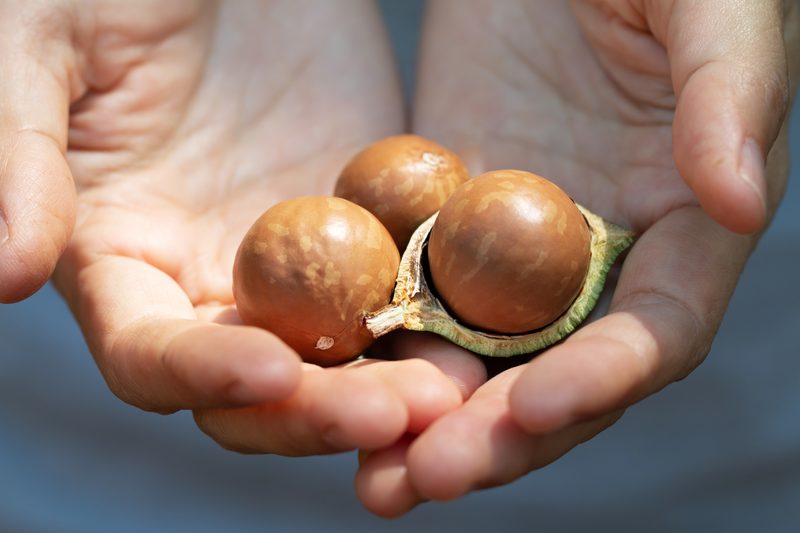
Most international macadamia trade is in nut-in-shell (NIS) — the dried nut still in its hard shell. Crackers and integrated processors prefer NIS because they crack and grade to their own kernel specification and capture that margin themselves. If you don't have cracking capacity, you may want finished kernel instead. NIS ships and stores well, which is why it dominates the bulk trade. Our export range is built around NIS grades.
Step 2: Choose your grade
Grade is driven by nut size and kernel recovery. As a rough guide:
- Premium NIS (>22mm): indicative $4,300–4,700/t. Best for the premium snack market and discerning Asian importers.
- Large NIS (>20mm): indicative $4,000–4,400/t. The workhorse grade for crackers and roasters.
- Graded Blend (18–22mm): indicative $3,500–4,000/t. Cost-effective for blending and processing.
- High KR Select (>32% tested): indicative $4,300–4,900/t. When kernel yield is the priority.
- Commercial Mixed: indicative $3,000–3,500/t. For industrial processing and oil.
Prices are indicative USD and move with the global market — see our explainer on what drives macadamia prices per tonne.
Step 3: Understand the Incoterms
You'll typically be quoted one of:
- EXW Chipinge — you arrange everything from the farm gate. Cheapest headline price, most work for you.
- FOB Beira / Durban — we deliver to the port and load the vessel; you take over the sea freight.
- CIF [your port] — we cover cost, insurance and freight to your destination port. Easiest for first-time buyers.
A standard 20ft container holds roughly 18–20 tonnes of NIS, which is the usual minimum order.
Step 4: Check the documentation
Legitimate export from Zimbabwe comes with a full document set. Expect: phytosanitary certificate, certificate of origin, fumigation certificate, bill of lading, packing list, and a commercial invoice in USD. SGS or Intertek third-party inspection can be arranged on request — for a first container, it's money well spent.
Step 5: Run a trial container
Don't sign a season contract off a sample alone. Request a sample and spec sheet, then place a single trial container. Crack and grade it against the agreed spec, confirm kernel recovery and defect rates, and only then negotiate volume terms. A grower-exporter confident in their quality will welcome this approach.
Buying for a specific market?
We maintain detailed buying pages for the largest destinations: China, Vietnam and the United States. For the bigger picture on sourcing direct, read choosing a Zimbabwe macadamia exporter.
When you're ready, send us a trade enquiry with your grade, volume and destination port — we reply within 24 hours.