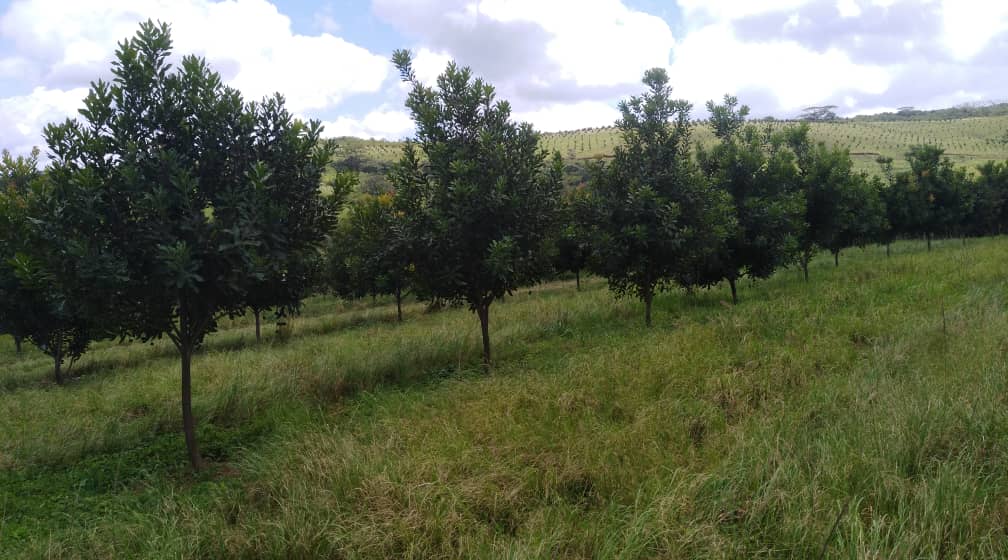
If you talk to macadamia growers across Africa, one cultivar name comes up again and again: Beaumont. Known formally as HAES 695, it's one of the most widely planted varieties in the southern hemisphere — and it's a backbone of our orchard at Umkondo Estate in Chipinge, Zimbabwe. Here's why it matters, for growers and buyers alike.
What is Beaumont (695)?
Beaumont is a hybrid of Macadamia integrifolia and Macadamia tetraphylla, originally selected in Australia and named after Dr J. H. Beaumont. It became popular precisely because it solved problems growers had with earlier varieties: it comes into bearing relatively young, yields heavily, and is vigorous and adaptable across a range of climates.
Why growers love it
- Early and heavy bearing: Beaumont trees crop young and produce reliably, which shortens the wait for a return on a new orchard.
- Vigour and adaptability: it performs across varied soils and altitudes, making it well suited to the Eastern Highlands.
- Attractive racemes: its striking pink flowers also make it a favourite ornamental — but it's the crop that pays the bills.
- Good kernel recovery: well-managed Beaumont delivers the 30%+ recovery buyers want.
One characteristic to manage: Beaumont nuts don't always abscise (drop) cleanly when ripe, so harvest timing and practice matter. On our estate we manage this with disciplined harvest rounds during the March–August season.
Why Zimbabwe suits Beaumont
The Eastern Highlands around Chipinge offer what Beaumont wants: altitude (our orchard sits at ~1,100m), reliable rainfall and deep, fertile red soils. Altitude slows nut maturation and helps concentrate oil, lifting kernel recovery and quality. The result is large nuts with high recovery — the combination that commands premium grades. We grow Beaumont alongside A-series cultivars (A4, A16) to balance the orchard and spread risk.
What it means for buyers
For importers and processors, a Beaumont-based orchard signals consistency. Because the variety is so well understood agronomically, its behaviour — nut size, kernel recovery, oil content — is predictable season to season. When a supplier can tell you the cultivar behind your container, you can plan your cracking yield with confidence rather than guessing.
This is exactly the kind of question our supplier checklist encourages buyers to ask. Knowing you're buying Beaumont NIS from a single high-altitude estate is a meaningful quality signal.
See the grades
Our Beaumont and A-series nuts are graded into the export range on our products page, from premium >22mm to high-KR select. To discuss cultivar, grade and volume for your market, send us a trade enquiry — or read more about sourcing from a Zimbabwe macadamia exporter.